

Featured in Bird Watcher’s Digest Magazine (May/ June 2014 issue)
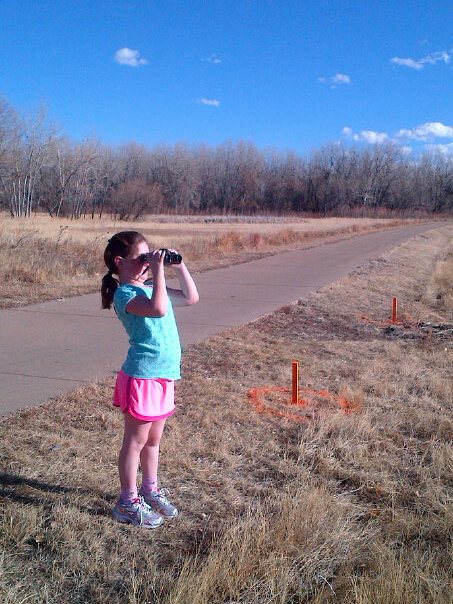
I feel a little tug on my hand that tells me she’s lost her footing. It’s a sensation I have felt countless times. It’s the feeling every parent gets when they hold the hand of a child who was walking alongside them one minute, then clinging to their hand for rescue from gravity’s unjust pull. It’s the moment you realize that, by holding on a little tighter, you can spare your child the pain of falling. In that moment, I realized that my daughter’s attention was not on the road ahead, but rather on the sky above. She was looking at the same red-tailed hawk I was, so transfixed by its effortless glide that she didn’t see the tree root jutting out of the ground. It was the moment I realized she was becoming a birder, like me.
Bruises and scrapes decorate my calves, leaving a speckled pattern that tells the story of my birding habits. I figure that it’s a hazard every birder faces: When you walk with your eyes on the sky, you are bound to stumble on bumps in the road. But, for me, birding (and all of its hazards) is a metaphor for my life.
Good birders need to keep their senses sharp—always prepared for the rare and majestic surprise but also prepared for inevitable disappointment more often than not—and miss the obvious obstacles in the middle of the path in doing so. Birding is not a contact sport, but anyone who does it on a semi-regular basis has at least one war wound. Like so many birders, I cannot sepa- rate myself from my love affair with these infinitely wondrous feathered creatures, no matter how hard I try to focus on what’s directly ahead of me.
It started when I was growing up in a low-income housing project. Not being able to afford the latest toys gave rise to creative exploration play, fostered by the fact that my neighborhood never really felt like “the projects.” Nestled at the base of the Colorado foothills, a spacious field butted up to our backyard. Deer would wander into our yard, nibbling on our grass or my mom’s garden. Foxes would cry at night in search of their mates. Small rodents served as a prix fixe for the snakes and foxes, and hawks and eagles routinely circled the field, looking for their next meal. I sat for hours at our chain-link fence, peering through the metal diamonds, transfixed by the wild- life on the other side.
Hawks were my favorites, because they were not shy about making their presence known. Everyone respected the hawk’s ability to provide both a show and pest control. But the mag- pies drew the most attention. They were “the mean birds” that picked on cats for no good reason. Neighbors cheered when Spookie, the neighborhood bully cat, brought home a dead mag- pie. I didn’t see the same thing everyone else did; I thought the magpie was beautiful, and I knew the cats did just as much rabble- rousing as the magpies.
As I got older, I started to realize that my home was unlike those of my schoolmates and friends. My clothes never had the vibrancy of theirs. And, I realized—most harshly—that my beautiful magpie was lowly in everyone else’s eyes.
I can’t remember exactly when, but I stopped going to the fence. I stopped watching birds and shut down to the wonder of nature. It didn’t seem right to keep my eyes focused through the fence when I needed to be finding a way to get to the other side. There wasn’t much time for birding through high school and most of college.
I married when I was young, and although my husband liked the outdoors, he was more of the conquering kind so often found in Colorado. His sights were focused more on the trail map than the sky. His pace was quick and breaks were meant to consume sustenance, not gaze at birds. “We can bag another 14er this weekend if we don’t take so many breaks to look at stuff” and “Come on! I’m sick of watching the same bird circle overhead for the billionth time,” he would say.
Then we had a daughter, and the prospect of “bagging a couple 14ers” in a weekend grew distant. But that didn’t stop him from trying. The baby provided the perfect excuse to go slow enough to gaze up at the sky or stop and look into a thicket as we passed
I realized— most harshly— that my beautiful magpie was lowly in everyone else’s eyes.
“I just need to slow down. She is getting upset from all of this jarring about,” I would say, as he impatiently took a swig from his canteen. When he would trek ahead, I would talk to our daughter, telling her how to tell the difference between a sparrow and a finch. I was no expert, in fact, I didn’t even have a field guide by which to tell the difference myself. But what I did have was the curiosity to look at something small and unassuming and try to note its unique characteristics. She cooed and gurgled, which I took it as a sign that she, too, liked birds.
As my husband and I taught her how to walk, we would walk with her hand-in-hand as she figured out how to balance on her own two feet. We became attuned to her movements through our hands. If she were starting to lose her balance, we would feel the wobble through her little fist as it tightened in ours. If she were looking up or down, we could feel the tug of her changed direction. On more than one occasion, she lost her balance while looking upward saying, “Pitty bidy, Mommy.” My heart beamed with pride every time she said that, because most of the time I was looking at the same thing. “You have to pay attention to where you are going, sweetie. Otherwise you will fall and get hurt,” my husband would say, although I am not sure to whom he was speaking.
That was years ago. My daughter is now eight, and my marriage has ended, leaving me free to walk with my daughter
at our own pace, eyes gazing upward, ears keen for the oppor- tunity to hear and see something special.
“Mommy, is that a kingfisher or a flycatcher?”
“You know, I don’t know. Let’s take a look through the ’nocs and then compare it to Peterson’s.”
She grabs the binoculars from my neck and peers out, searching for the bird perched atop the tall cattail stalk.
“Did you find it?” I ask as we continue to walk, hand-in-hand.
“No, it flew away,” she says, sud- denly on another bird that has entered her magnified eyesight. It’s a hawk and it has a couple of friends with it.
She rests the binoculars on her chest and we walk hand-in-hand looking almost straight up as the three red-tailed hawks circle above, gliding, swooping. Trans- fixed, we can’t tear our eyes from the majestic predators.
“It’s springtime, so you know what they are doing, right?” After contemplating, she responds, “Mating?” “Sort of. The males are competing to see who will be the best mate for the female. They each try to get close to her, but as soon as one gets close, the other swoops in to tell him to back off.”
Ad-libbing a mock conver- sation between the males, and then pretending to be the object of their desire, we giggle at our- selves. Suddenly, I feel her hand tug downward. Our reverie is broken, because I know that feeling instantly: She is falling. In a microsecond, I grab her hand tighter and gently pull upward, preventing her from a sharp introduction to the gravel ground below us. In the split second when her body was free-falling toward the ground, my heart sank, thinking about how she could hurt herself. Then that anxiety was replaced by my own memories of pain incurred while watching birds, first as a child realizing that my lot in life was less than ideal, then as an adult trapped in a loveless and unsupportive marriage, and now as a parent worried for her child’s safety.
“Whoa! Careful there,” I say, but her eyes are already back on the hawks. With her fall averted, she is no longer concerned about anything else, and, I realize, neither am I.
“I think those are adolescent hawks,” I say, looking at her as I speak. “What does adolescent mean?” she asks, eyes still gazing at the hawks dancing in the sky. “It means not mature yet, like a kid or teenager. See how their tails aren’t quite red all the way through? That means that they aren’t adults.”
“Mom, after this do you want to go home and watch The Big Year?” she asks. “Yes, I do,” I say with a wilted smile, as I hold back my tears of pride and relief that she loves the birds as much as I do and that, unlike me, she won’t have any reason to hide her love affair, nor will she draw corollaries to stumbling on obstacles in her path with looking to the sky.
 CHELSY WOODS KLEIN
Leave a comment